



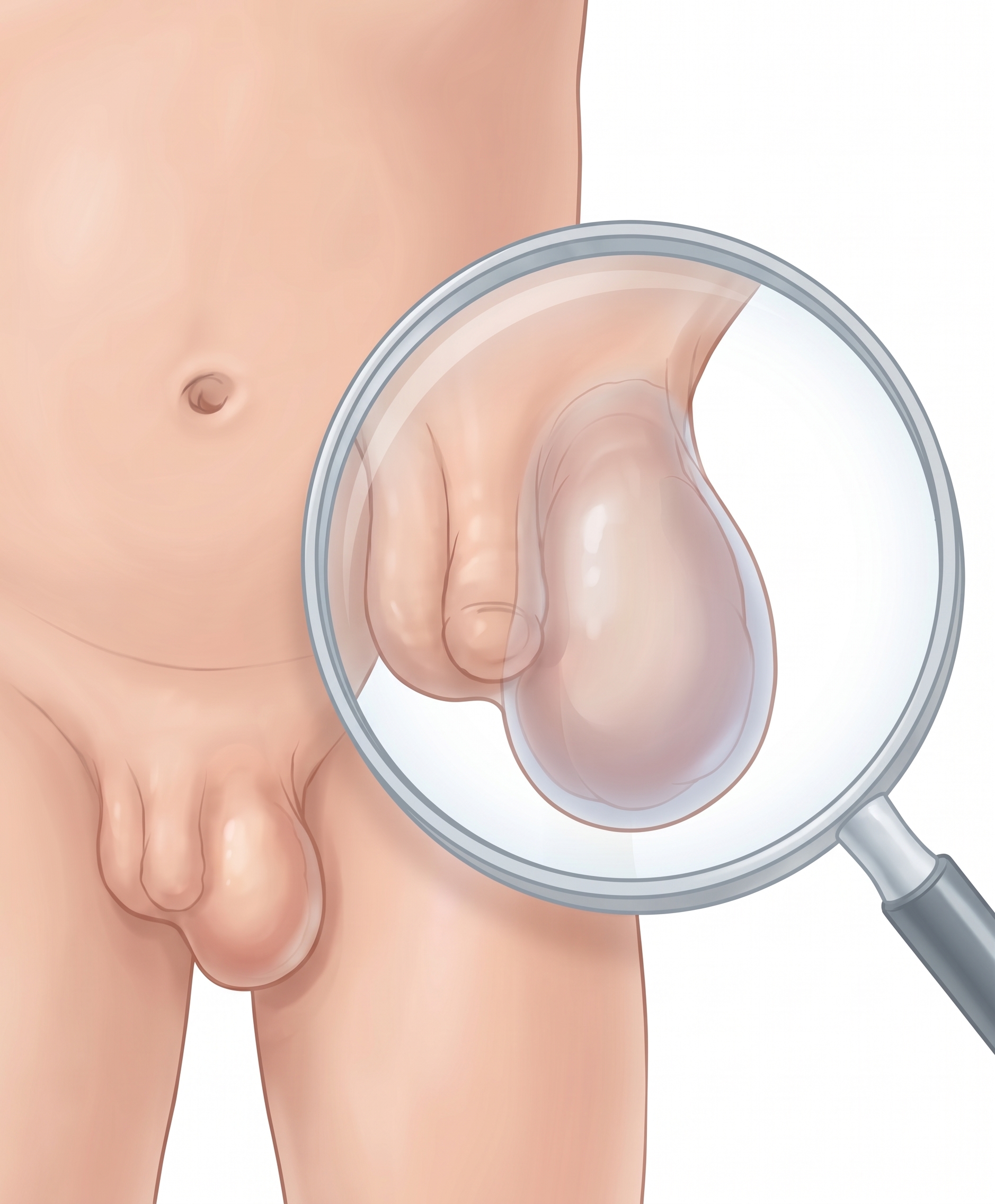
Why Does It Occur?
During fetal development, the testicles descend from the abdomen into the scrotum through the inguinal canal, accompanied by a small sac of the abdominal lining (processus vaginalis).
-
Communicating Hydrocele: If this passage fails to close completely after birth, fluid from the abdominal cavity travels down into the scrotum. The swelling typically increases when the child is active or crying and decreases while resting or sleeping.
-
Non-communicating (Isolated) Hydrocele: The channel has closed, but the remaining fluid is trapped around the testicle.
Common Symptoms:
-
Smooth, painless swelling in one or both sides of the scrotum;
-
The swelling feels soft and fluid-filled;
-
Fluctuations in size throughout the day (characteristic of communicating hydrocele).
Management and Treatment:
-
Watchful Waiting: Most congenital hydroceles resolve on their own by 12 to 24 months of age as the passage closes and fluid is naturally absorbed.
-
Specialist Evaluation: An examination by a pediatric urologist (and an ultrasound, if indicated) is important to confirm the diagnosis and rule out an inguinal hernia.
-
When Is Surgery Needed? If the hydrocele persists past the age of 1.5–2 years, becomes excessively large, or is associated with an inguinal hernia, a minor elective outpatient procedure is performed.
When to seek immediate care: If the scrotal swelling appears suddenly, becomes tender/painful, red, or if the child starts vomiting, seek immediate emergency pediatric evaluation to rule out testicular torsion or an incarcerated hernia.


